Scuba diving is a form of underwater diving where the diver uses a self-contained underwater breathing apparatus (scuba) which is completely independent of surface supply, to breathe underwater. Scuba divers carry their own source of breathing gas, usually compressed air, allowing them greater independence and freedom of movement than surface-supplied divers, and longer underwater endurance than breath-hold divers.Open circuit scuba systems discharge the breathing gas into the environment as it is exhaled, and consist of one or more diving cylinders containing breathing gas at high pressure which is supplied to the diver through a regulator. They may include additional cylinders for decompression gas or emergency breathing gas. Closed-circuit or semi-closed circuit rebreather scuba systems allow recycling of exhaled gases.

Depth Range:
The depth range applicable to scuba diving depends on the application and training. The major worldwide recreational diver certification agencies consider 130 feet (40 m) to be the limit for recreation diving. British and European agencies, including BSAC and SAA, recommend a maximum depth of 50 metres (160 ft) Shallower limits are recommended for divers who are youthful, inexperienced, or who have not taken training for deep dives. Technical diving extends these depth limits through changes to training, equipment, and the gas mix used. The maximum depth considered safe is controversial and varies among agencies and instructors, however, there are programs that train divers for dives to 120 metres (390 ft).

Equipment:
Breathing apparatus:
The defining equipment used by a scuba diver is the eponymous scuba, the self-contained underwater breathing apparatus which allows the diver to breathe while diving, and is transported by the diver.
Open-circuit:
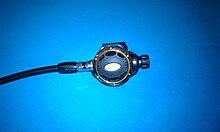
Open circuit scuba has no provision for using the breathing gas more than once for respiration.The gas inhaled from the scuba equipment is exhaled to the environment, or occasionally into another item of equipment for a special purpose, usually to increase buoyancy of a lifting device such as a buoyancy compensator, inflatable surface marker buoy or small lifting bag.
Rebreather:
Less common are closed circuit (CCR) and semi-closed (SCR) rebreathers which unlike open-circuit sets that vent off all exhaled gases, process all or part of each exhaled breath for re-use by removing the carbon dioxide and replacing the oxygen used by the diver.

Underwater vision:
Water has a higher refractive index than air – similar to that of the cornea of the eye. Light entering the cornea from water is hardly refracted at all, leaving only the eye's crystalline lens to focus light. This leads to very severe hypermetropia. People with severe myopia, therefore, can see better underwater without a mask than normal-sighted people.
Thank you...
Well done🤘
ReplyDeleteWow... Vey useful👍👌🙌
ReplyDeleteVery nice👌 found very interesting👍
ReplyDeleteVery nice.. 😊 keep it up.
ReplyDeleteVery informative 👍
ReplyDeleteNice Information
ReplyDeleteThis comment has been removed by the author.
ReplyDeleteMast
ReplyDeleteGood One.. keep it up
ReplyDeleteGood One.. keep it up
ReplyDeleteNice one!!!!
ReplyDeleteManchester city rockss
ReplyDeleteWoowwwwww ..... 🙂
ReplyDelete